Sunday, March 4, 2012

Krong Koh Kong


Once a large port town on an even larger delta, Koh Kong is now a rundown yet charming old dusty town.  It is the gate way to the Cardamom Mountains and the Koh Kong Conservation Corridor.  These two protected areas are home to some of SE Asia's largest virgin forests and mangroves, and a wide variety of endangered species.

Koh Kong Island


Lagoon
We stayed here for 4 days, and probably our most memorable day was at Koh Kong Island.  This island is like a postcard...white sand beach, crystal clear turquoise water, a fresh water lagoon, coconut palms swaying in the breeze...and empty.  Unfortunately there are plans to build an airport, golf course, and a resort on the island in the near future but the hope is that the areas 'ecotourism' possibilities will keep development more nature oriented than say Bokor Hill NP.


Mangroves

We also took a 'trek' into the Cardamom Mountains to a waterfall for some swimming.  We had two locals guiding us, maneuvering our boat through narrow mangrove channels barley deep enough to wade in...and chopping down coconuts for us to enjoy by the falls.  On our ride back down the river from the hike we were caught in a down pour that lasted about 20min and soaked us all, the force of the rain was amazing!

Cardamom Mountains


The downpour!

Kampot

February 20, Amanda's birthday, and an overnight bus ride that was only 5 hours long instead of 7 (a problem when you plan to sleep) and both of us having broken seats, lead to a long day before we finally reached Kampot.  I had ribs, fires and lemon meringue pie for dinner...it made up for it!
Kampot was touted as a 'sleepy little river town' with Cambodia's best colonial French architecture.  We however thought otherwise, large industrial and rundown... that's what we would have put in the guide book...


Bokor Hill Station
Gate to the 'Ghost town"
The main attraction in town, is an old French resort and town in what is now a National Wildlife Reserve.  We took an organized tour to see the 'ghost town' as it was advertised, with a 'trek' through the jungle, a waterfall, and a sunset river cruise...all for $10 and it included lunch.  Well it turns out that a Chinese company bought the park and were in the process of rebuilding some of the old French buildings as well as building some large Casinos of their own.  All this meant that our jungle 'trek' was through a construction site, the 'ghost town' was either being renovated and was off limits or the  re-inhabited by the workers, and he water fall was dry because its the dry season...all things they failed to mention!  The lunch was good and so was the river cruise...and hay it was only $10!

Dry Waterfall 

Sunset cruise


Battambong


We took a tour of the area by tuk tuk, with a driver named 'Ya Ya'.  He took us to see the 'killing caves' as they are so blatantly named.  This region of Cambodia was part of the Khmer Rouge strong hold and during their actual reign the fields around this region were used as slave camps where the Khmer Rouge forced thousands of 'city folk' to the fields in forced labor, if they resisted they were bludgeoned and then thrown into the killing cave...
A shrine of human bones is now found at the base of the cave commemorating the deceased, along with a statue of a Buddha.  At the top of the limestone outcrop that houses the cave is a Wat and two 'large guns' that the Khmer Rouge used after they were ousted from Phnom Penh by the Viet Nameses


We then went on a drive through 'wine country'...one vinyard to be exact and then on to Prasat Banan, a temple built in the 11th century and thought to be the inspiration for Angkor Wat (though 1/8 the size)


Ben liked the small doors...
We also found a blue headed lizard and quiet a few monkeys

The last stop was the 'Golden Gate Bridge' of Cambodia...it was blue...also 1/8th the size

The slow boat to Battambang

Not our boat...this boat was bound for Phnom Penh

We left Siem Reap on a slow boat to Battambang (Fe 18th), a small town on the other side of Tonle Sap Lake.  During high season the boat trip is an easy 5 hours but we were approaching dry season and it took us over 9 to reach the town!  The views were stunning but the ride was a bit too long...
Tonle Sap lake is the largest fresh water lake in SE Asia and is quiet remarkable because, not only does it supply Cambodia with most of its fish and fresh water, it also reverses flow twice a year, once during the dry season it flows into the Mekong river and during the monsoon season the river flows into it swelling the lake to nearly twice the size.


We passed many floating villages along the river with smiling children eager to wave at the passing boat.


Preah Khan


February 17.  Preah Khan was our favorite temple at Angkor.  The temple was largely left to ruin and the jungle, therefore it was shaded by the trees growing amongst the ruins and was little visited by tourists.  It was built by non other than Jayavarman VII in the 12th century as a Buddhist university.  Many of the Buddha images through out the complex have been defaced after the kings reign ended because at that time his kingdom was largley Hindu (now Cambodia is 90% Buddhist)


Saturday, March 3, 2012

Angkor Thom

Bayon


February 17.  Angkor Thom the 'Great City' was built in the 12th century by who else...Jayavarmn VII as the capital of the Khmer kingdom.  12km in size, it out does all else but Angkor Wat in splendor and size.  It is believed to have been the undoing of the empire because of the cost of labor and raw materials, and the speed with which it was built.

Bayon, a temple devoted to the Bodhisattva of compassion Avalokiteshvara with 216 carvings of his face, though some think the likeness to the king is striking...


South Kleang and the Prasats, was from the old palace.  The Prasats, or towers were said to have had a rope strung between them where tight-rope walkers would preform for the king


Baphuon, a pyramid of sorts depicting the mythical Mt Meru and the Center of the city, Built in the 10th century in the old capital.  In the 60's it was taken appart in an attempt to reassemble the pieces but all the notes were lost during the civil war and now much of it lies in organized piles that no one knows what to do with...


Phimeanakas was the area of the palace though little still remains, this was thought to be a tower that the king would use as a look out.

At the top of the look out


The terrace of the Elephants served as the kings grand audience hall and public ceremonies


The entrances accross the moat from the East and West represent the myth of the 'churning of the ocean of milk'. Here we had a ride on our bikes with a local Khmer boy who wanted to practice his English so he took us to the less visited West Gate


Angkor Wat


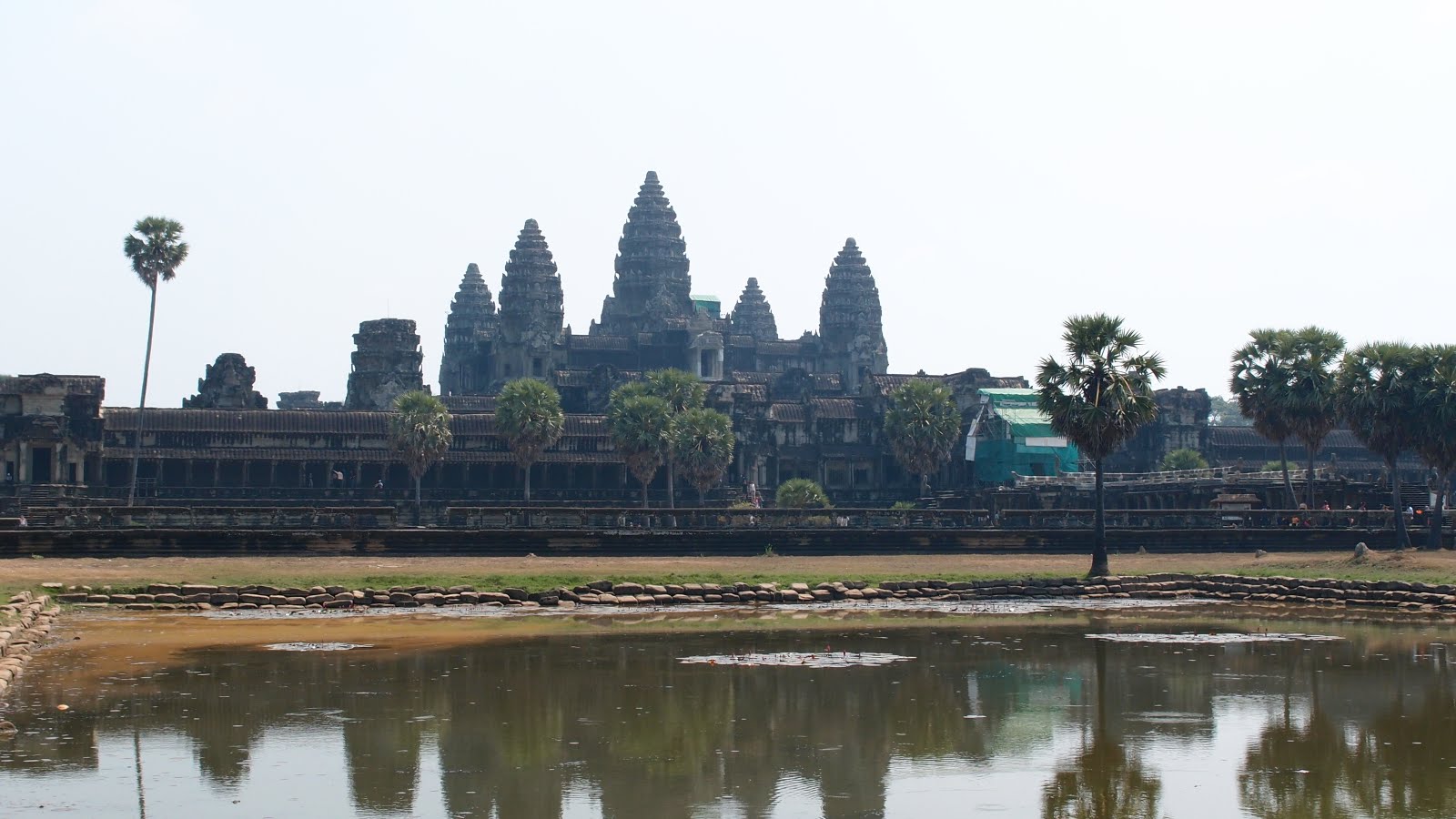
February 16  We left our guest hous at 5am to bike to Angkor Wat to see the sunrise with thousands of other tourists, luckily when the sun came up most of them went back to town for breakfast so we could explore the temple in the cool quiet morning...at about 9am the tour buses full of Japanese arrived and all quiet went out the window.


Hunaman (a god) holding the serpent's tail
Angkor Wat, the pinnacle of the Khmer reign and the pride of modern Cambodia.  This temple, literal 'city temple' was never fully abandoned and is therefore in excellent condition.  It was built in the 12th century by Suryavarman II and dedicated to the Hindu diety Vishnu.  It is built, like many temples at Angkor, to represent the mythical Mount Meru, the center of the Hindu Universe and the mount of the gods.  It is surrounded by a 608ft wide moat with elaborate entrances gates at the East and West.  Around the outer wall of the Temple is a base relief that covers over 2560ft (nearly 1/2 a mile!) depicting various Hindu stories as well as a few stories of the king's conquest.  The most famous being the story of the 'Churning of the Ocean of Milk' where the gods and daemons battle over a naga (serpent) in the water who is churning the sea to extract the elixir of immortality... thankfully the gods win.